 Arab Republic of Egypt · Official portal — Alexandria Governorate
Highlights
- 1Villa of the Birds mosaics
- 2The Roman baths
- 3Byzantine lecture halls
- 4Thirteen tiers of marble seating
The story
In autumn 1960 a Polish team led by Professor Kazimierz Michałowski began a salvage dig at Kom El Dikka, where a municipal administration building was planned in place of a ruined Napoleonic fort. In 1964, as machines drove the foundations for a new theatre, part of an ancient arch appeared: it was a Roman theatre, and the building work was stopped at once. Thirteen rows of marble seats were cleared, in the shape of a horseshoe.
Strictly, the building is an odeon — a hall for music and poetry — built most likely in the 4th century AD beside the imperial baths and rebuilt in the 6th. It sits within the wider Kom El Dikka site, one of the most significant archaeological areas embedded in Alexandria’s urban fabric, which also holds Roman baths, the Villa of the Birds with its fine mosaic floors, and the lecture halls of a teaching complex built in the late 5th and 6th centuries.
From marble tiers to mosaic floors, the site offers a way to read the life of the ancient city: learning, bathing and gathering within one urban setting.
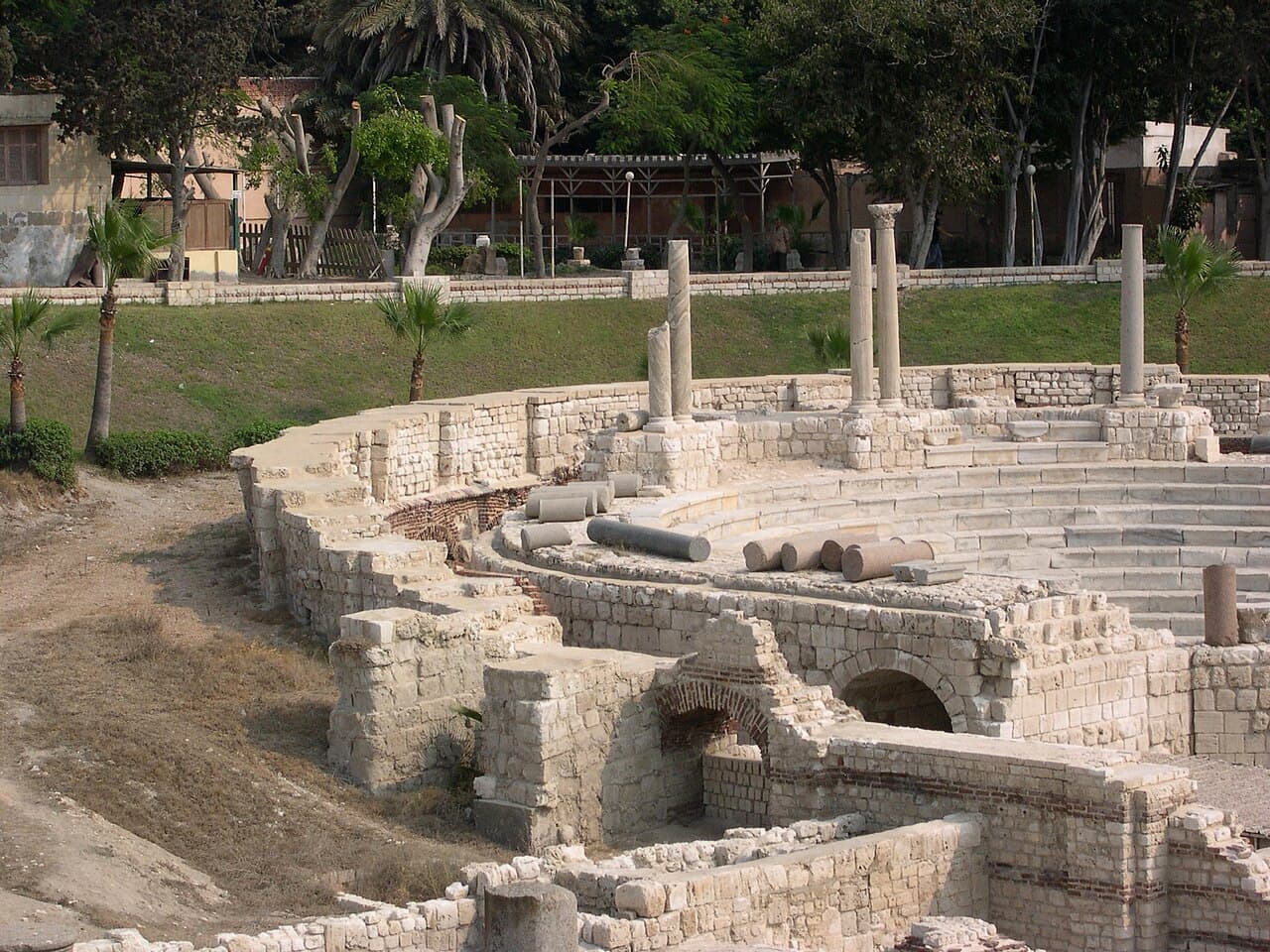
The Kom El Dikka site from above: the amphitheatre, its columns and the remains of the Roman baths