Downtown DistrictAlexandria Governorate
Arts & cultureThe Statue of Nubar Pasha

Arts & cultureThe cosmopolitan city

The Statue of Nubar Pasha

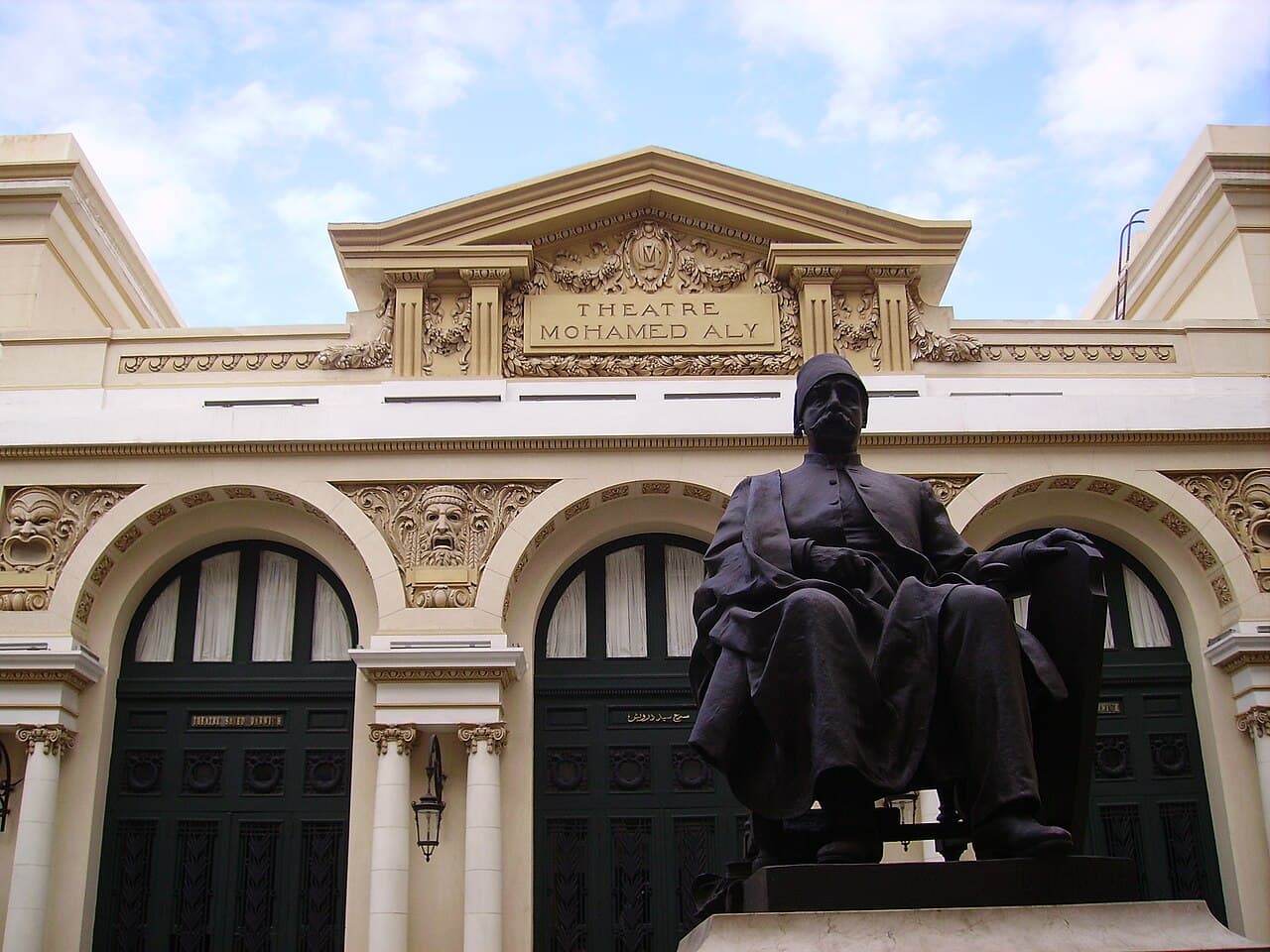
Near Sayed Darwish Theatre, Nubar Pasha’s statue commemorates Egypt’s first prime minister.

The cosmopolitan city
Unveiled in 1904, according to a museum record
Opening hours
Outdoors, at any hour
Tickets
No entry fee
Administrative section
El Attarin — in front of the opera house

What sets it apart

A seated figure in a tarboosh, his hand on a tablet inscribed in French “Justice is the foundation of all government”, a maxim repeated on the pedestal.

9 documented memories

Its place in time

The cosmopolitan city · 1860 – 1950

The district at the height of its plurality: Greek, Italian, French, Levantine, Jewish and Armenian communities; the tram, theatres, hotels and cafés; classical, Art Nouveau and Art Deco buildings.

Highlights

  • 1The seated statue
  • 2The French maxim on the tablet and pedestal
  • 3The Sayed Darwish Theatre behind it
  • 4Its closeness to Nabi Daniel Street

The story

  1. Nubar Pasha (1825–1899) was an Egyptian statesman of Armenian descent who headed Egypt’s first council of ministers in 1878 and returned to the office twice more.

  2. The statue, by the French sculptor Denys Puech, shows him seated, his left hand resting on a tablet inscribed in French “La justice est la base de tout gouvernement” (justice is the foundation of all government); the same maxim appears on the pedestal.

  3. According to a museum record, it was unveiled in 1904. It first stood in the Municipal Gardens — today’s Shallalat Gardens — where E. M. Forster saw it in 1922. Dismantled after the 1952 revolution and kept in storage for years, it reappeared around 2000 at a new site: the entrance of the opera house, the Sayed Darwish Theatre, on Fouad Street.

  4. Its position near the theatre places this political biography among other cultural landmarks, including Cavafy’s house and the Eliyahu Hanavi Synagogue on Nabi Daniel Street.

Memories of the place

Every memory is taken from a published, documented source.

  1. January 1825

    Nubar was born at Smyrna (İzmir), the son of an Armenian merchant.

  2. 28 August 1878

    A khedivial decree created Egypt’s first responsible cabinet, headed by Nubar; he returned as premier in 1884 and again in 1894.

  3. January 1899

    Nubar Pasha died in Paris, aged seventy-four.

  4. 1903

    According to a museum record, the French sculptor Denys Puech made the statue in 1903, seated on a chair and holding a tablet inscribed in French “La justice est la base de tout gouvernement” (justice is the foundation of all government).

  5. 1904

    The statue was unveiled, according to the same museum record.

  6. 1922

    E. M. Forster saw the statue standing in the Municipal Gardens — today’s Shallalat Gardens — visible from the tram, and wrote that “the tarboosh is too large but the general effect dignified”.

  7. After 1952

    The statue was dismantled after the 1952 revolution, along with that of Khedive Ismail.

  8. Around 2000

    The statue reappeared at a new site in the city, with no explanation given; today it stands at the entrance of the opera house, the Sayed Darwish Theatre.

  9. 14 February 2021

    Hay Wasat began a campaign with the antiquities restoration department to maintain and clean the city’s heritage statues, including Nubar Pasha’s at the opera house.

Around it